
In 2025, the Flexible RF Technology Research Center of Southeast University published a research paper entitled "Interwoven MXene Sediment Architecture Empowers High-Performance Flexible
Microwave Devices" in the journal Small (impact factor 13.3 ).
Flexible microwave devices are crucial in wearable electronic systems used for wireless communication, and highly conductive materials are essential for ensuring optimal electromagnetic
performance. MXene, renowned for its excellent conductivity, lightweight nature, and ease of fabrication, has emerged as a promising alternative . However, the technical limitations of MXene
suspensions or deposits pose significant challenges to their practical application in the low-cost and scalable production of high-performance microwave devices. Here, an interwoven MXene
deposition architecture is designed on a naturally cross-linked fabric, achieving both high material utilization and superior conductivity. This architecture breaks away from the planar
conductivity of traditional stacked MXene films, promoting multidirectional electron transport and boosting the conductivity of MXene-deposited microwave devices to 1.6 × 10⁶ S/m.
The underlying mechanisms for this conductivity enhancement . Furthermore, this architecture exhibits excellent electromagnetic interference shielding and supports high-quality, long-range
wireless communication. This validation not only highlights the effectiveness of the interwoven MXene deposition architecture but also establishes MXene-based microwave devices as a
transformative component for next-generation high-performance flexible wireless communication technologies.
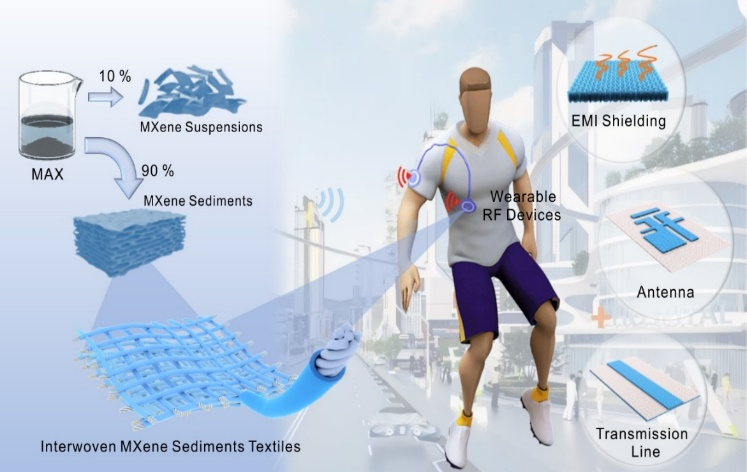
Figure 1. MXene deposition architecture
This innovative model maps parameter information to a quantum-enhanced feature space, requiring only a few qubits for encoding and evolution, far smaller than the available scale of existing mesoscale quantum devices. Finally, the research team conducted numerical experiments on a quantum simulator, demonstrating that SED-HVQA can quickly and accurately calculate the electromagnetic properties of finite-periodic structures. Especially in scenarios with strong edge effects such as corner units, the learning efficiency is improved by 27%–62%. Furthermore, when the number of training samples is reduced to 10%, the model exhibits a robustness improvement of 22%–59% across all unit types.
Figure 2 The learning efficiency and robustness of SED-HVQA are significantly improved compared to classical neural networks
This research, through the deep integration of the SED method and hybrid quantum algorithms, breaks through the limitations of classical neural networks in terms of learning performance and sample dependence, opens up a new path for quantum computing-assisted electromagnetic simulation, and provides an innovative solution for the efficient design of periodic structures such as frequency-selective surfaces, metasurfaces, and phased array antennas.
Paper Information
Song W, Yu B Y, Ju L, et al. Interwoven MXene Sediment Architecture Empowers High‐Performance Flexible Microwave Devices[J]. Small, 2025: 2503857.
https://onlinelibrary.wiley.com/doi/full/10.1002/smll.202503857


 京公网安备 11010802027423号