
Recently, Professor Weibing Lu’s research team from the Center for Flexible Radio Frequency Technology, Southeast University, and the School of Information and Intelligent Sciences, Donghua University, has proposed a deformation-insensitive millimeter-wave antenna based on liquid metal textiles, providing a new solution for next-generation wearable body area network communications. The related work, entitled“Printable Liquid Metal-Textiles for Deformation-Insensitive and Electromagnetically Robust mmWave Devices”, was published in the internationally renowned journalAdvanced Science. Dr. Lu Ju and Dr. Buyun Yu are the co-first authors, while Prof. Weibing Lu, Prof. Cunjiang Yu, and Prof. Yingshi Guan are the co-corresponding authors.
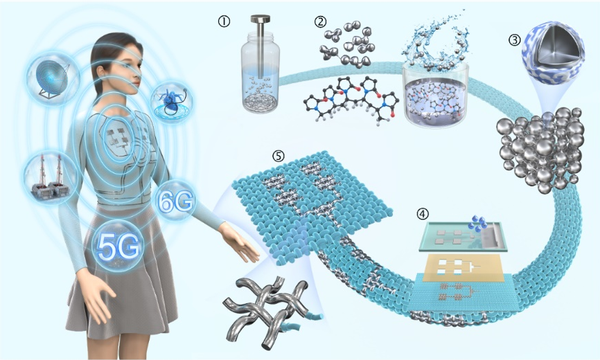
Figure 1 High-performance textile millimeter-wave antenna with mechanical durability and electromagnetic robustness.
Research Background and Challenges
With the rapid development of 6G and the Internet of Things, millimeter-wave technology has become the key to constructing next-generation body area networks due to its high bandwidth and high data transmission rate. However, limited by inherent physical characteristics, millimeter-wave devices are extremely sensitive to metal loss and structural stability of conductive paths. Even a slight decrease in conductivity will degrade or even distort the electromagnetic performance of millimeter-wave antennas.
Traditional metal materials are prone to irreversible cracks or delamination under complex dynamic deformations such as bending and stretching, leading to a significant decline in conductivity. Therefore, how to achieve high-performance and electromagnetically robust millimeter-wave devices that remain stable under repeated mechanical deformations is a critical technical challenge for flexible wearable radio-frequency devices.
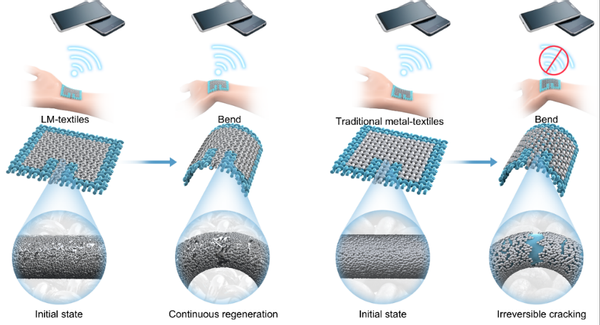
Figure 2 Textile antennas based on (a) liquid metal and (b) traditional rigid conductive materials.
Core Technical Innovations
Gallium-based liquid metal is an ideal flexible conductive material for millimeter-wave applications due to its metal-like high conductivity, intrinsic flexibility, and self-healing properties. However, its fluidic nature results in high surface tension, making high-precision patterning on complex porous textiles difficult.
At present, most liquid metal-based microwave devices rely on traditional microchannel fabrication, which usually requires complex equipment and tedious processes. Moreover, they tend to deform under vertical or tensile stress, leading to unstable conductivity. Therefore, it is still challenging to realize stable, reliable, and scalable high-performance textile millimeter-wave devices.
A Highly Conductive, Reliable, and Printable Liquid Metal Ink for Textiles
Textiles are not resistant to high temperatures and feature rough and porous surfaces, resulting in poor compatibility with existing mature flexible manufacturing and integration technologies. Current technical routes for constructing radio-frequency devices on textile substrates mainly include metal structure transfer and in-situ intrinsic conductive network construction.
However, these two schemes mostly rely on conductive materials such as metal nanowires, conductive polymers, or carbon nanomaterials, which are prone to interface detachment and delamination under large repeated deformations, causing distortion of the electromagnetic performance of millimeter-wave devices.
To solve the problem of poor electrical stability in current textile electronics, this work proposes a functionalized liquid metal ink highly compatible with textiles, which exhibits high conductivity and deformation resistance. Through the synergistic effect of nanoscale effects and surface modification, the functionalized liquid metal ink can be uniformly and fully deposited in the three-dimensional network structure of textiles to form continuous and stable conductive paths.
In addition, the functionalized liquid metal ink shows typical shear-thinning behavior, adjustable viscosity, and high yield stress, ensuring high-precision patterning on the textile surface. Benefiting from its unique electrical self-healing property, the electronic textile based on this liquid metal ink can maintain a uniform sheet resistance of approximately 11.16 mΩ/sq even after repeated mechanical deformations, significantly improving the stability and reliability of textile millimeter-wave devices.
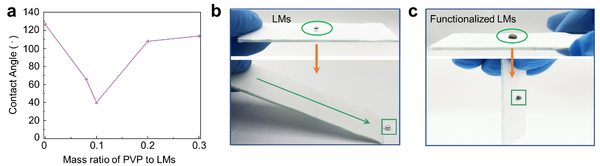
Figure 3 Compatibility characterization of functionalized liquid metal ink and original bulk liquid metal on textile surfaces.
A “Dual-Mask” Printing Process for Preparing High-Precision Liquid Metal Textiles
At millimeter-wave frequencies, radio-frequency devices are extremely sensitive to conductor loss and structural accuracy. To address this challenge, this work innovatively proposes a high-resolution “dual-mask” printing strategy to achieve high-precision and high-conductivity patterning on textiles.
Specifically, as the upper mask, the screen-printing mask is used to pattern fine structures on textiles and ensure uniform deposition of the functionalized liquid metal nano-ink. As the lower mask, a customized template mask based on thermal-release tape can reduce the edge diffusion of ink on the textile surface on the one hand, and act as a physical barrier to restrict the disorderly migration of the gallium oxide layer during liquid metal activation on the other hand, thus protecting the printed radio-frequency structures.
This “dual-mask” printing strategy organically integrates the high-throughput advantage of stencil printing and the high-resolution characteristic of screen printing, realizing high-precision and high-reliability millimeter-wave radio-frequency devices on textile substrates.
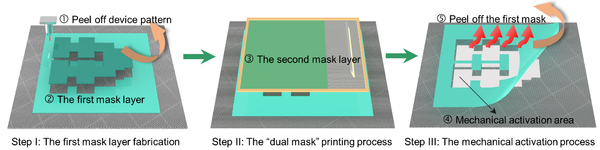
Figure 4 “Dual-mask” printing process.
Liquid Metal Textile Millimeter-Wave Devices with Excellent Mechanical Durability and Electromagnetic Robustness
Based on the synergy of the specially designed functionalized liquid metal ink and the high-resolution “dual-mask” printing technology, this work successfully constructs deformation-insensitive and electromagnetically robust liquid metal textiles, realizing high-performance millimeter-wave devices that can maintain stable and reliable electromagnetic transmission under repeated deformations.
To verify the effectiveness of this strategy, a liquid metal textile antenna array operating at 26 GHz was fabricated. Experiments show that the antenna can maintain a stable gain of 9.65 dBi after repeated bending. In addition, a microstrip transmission line based on liquid metal textiles was prepared, and its transmission performance is almost unchanged after bending and other deformations.
Compared with textile antennas based on commercial conductive silver paste and metal cloth, the proposed liquid metal textile antenna shows superior mechanical reliability and can still achieve a high-definition image wireless transmission distance of 4.5 meters after mechanical deformation, further verifying its feasibility in practical application scenarios.
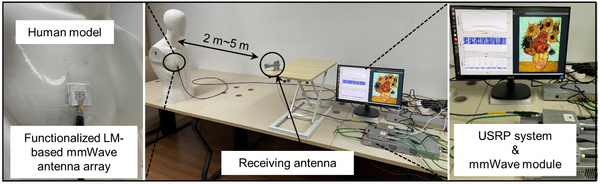
Figure 5 Wireless communication test of the liquid metal millimeter-wave textile antenna.
Conclusion and Outlook
At millimeter-wave frequencies, radio-frequency devices have extremely high requirements for conductor loss, structural accuracy, and reliability. Slight performance degradation can lead to attenuation or even distortion of electromagnetic properties. To address this challenge, this work proposes a liquid metal textile with both mechanical durability and electromagnetic robustness, providing a new technical route for constructing next-generation high-performance wearable millimeter-wave devices.
Funding
This work was supported by the Major Project of the Shanghai Municipal Science and Technology Commission (Grant No. 25DX1400200), the Key Basic Research Program of Jiangsu Province (Grant No. BK20243015), the Fundamental Research Funds for the Central Universities (Grant No. 2242022k60004), the Key Program of the National Natural Science Foundation of China (Grant No. 62231001), the Jiangsu Funding Program for Excellent Postdoctoral Talent (Grant No. 2024ZB501), and the China Postdoctoral Science Foundation (Grant No. GZB20240140).
Original Article
L. Ju, B. Yu, R. Wang, et al. Printable Liquid Metal-Textiles for Deformation-Insensitive and Electromagnetically Robust mmWave Devices.Advanced Science, 2026. http://doi.org/10.1002/advs.202522350


 京公网安备 11010802027423号